From Waiting to Movement

From Waiting to Movement

Something completed for me this morning.

Not intellectually.
Somatically.
Quietly.

I saw how a real spiritual insight from years ago
turned into a frozen strategy.

Not out of fear.
Out of reverence.

I didn’t want to mess it up.

So I waited.

What I see now is simpler — and more adult:

I was never meant to wait for provision.
I was meant to move from source.

Alignment first.
Action second.
Money as expression, not savior.

So today I formalized it.

A prayer.
A practice.
A reminder on the wall.

Not to ask life to deliver something to me —
but to let life move through me.

That chapter feels complete now.

Which means I get to do what comes next.

I’ll make money.
I’ll build.
I’ll create.
I’ll take responsibility for the work that’s mine to do.

Just not from lack.
Not from waiting.
Not from outsourcing fulfillment.

Action is sacred
when it flows from emptiness.

Time to move.

Game Night

From counting squares and colors, requiring pattern recognition and planning ahead…
to the scarcity of moves on a desert planet…
to joining together against an elder one and his cultists…

Jennie and Riley and I had quite a weekend.

As you know…
lots has been going on.

Heavy.
Sad.
Growing… but challenged.
Loving… but frustrated.
Open… but hurting.

All of that comes together around the table—
sometimes as competition,
sometimes as collaboration,
depending on which game you play.

Regardless of the game,
it’s all family.
Challenge.
Presence.

And the bonds that form between us
when we sit across from each other,
thinking, laughing, scheming,
sometimes winning... sometimes losing… but always together.

Karmic Conscious Purpose

There’s something I’m seeing and feeling and becoming more aware of…
more clearly.

I am driven to do certain things.

Make money.
Build a life.
Love a woman.
Raise children.
Create.
Write.
Finish projects.
Leave something behind.
Go on adventures.
Improve myself.
Grow the fuck up.
Help other people connect with the divine inside themselves.

A modern-day shaman — only I don’t help you connect to spirits of the world,
but to the spirit inside yourself.

Those drives are real.
Biological.
Karmic.
Human.
From culture, from childhood, from nature.

And I keep making the same mistake with them:

Because I’m driven toward something,
I vastly assume it’s supposed to fill me.

As if getting the wife,
or the money,
or the success,
or finishing the thing…

…is what will finally make my heart feel whole.

That’s where the trouble starts.
Big trouble.

Because those things were never meant to do God’s job.

I can feel it in my body when I do this.
A tightening in my throat.
A subtle pressure.

Like I’m asking life to sign a contract
it never agreed to.

The reframe that’s landing for me is simple — and humbling:

I’m driven to do the things I’m driven to do
in order to do them.

Not to be completed by them.
Not to be saved by them.
Not to be fulfilled by them.

They’re the story.
The drama.
The movement that keeps life from being static empty space.

They’re movements.
Expressions.
Chapters.

They can feel good.
They can be beautiful.
They can even be sacred.

But they are not the source.

When I stop asking people, money, or outcomes
to complete me…

Something relaxes.

Love gets lighter.
Work gets cleaner.
Desire stays — but without desperation.

I still write the book —
but I’m not white-knuckling it as proof I matter.

I still show up for Jennie —
but I’m not secretly asking her to fix the unfixable.

I still facilitate men’s work —
but I’m not performing for my own salvation.

Life… deepens.

It feels totally different.
It can’t even be explained how different it feels.

It’s something on a different order —
like the difference between caterpillar and butterfly.

Lighter.
More spacious.
Like breathing underwater suddenly became possible.

I still build.
I still pursue.
I still care deeply.

I’m just no longer confusing
karmic drive
with existential fulfillment.

Hard Alignment

This morning I aligned hard.

My wife stormed around the kitchen—resenting me for taking my time.
My nervous system wanted to spiral about ICE raids and political bullshit.
Resistance squeezed my throat.

I stayed anyway.

Body scan. Inner smile.
Witness the storm without jumping in.

Here’s what I’m learning:
resistance isn’t the enemy.
It’s the riverbank—the masculine container that lets the flow happen.

Politics, fear, the closed heart across the hall—
they show me what I don’t want
so I know where to turn my focus.

So I smiled at the squeeze,
breathed into the empty space between breaths,
and chose the refuge instead.

The NOW isn’t some woo-woo escape hatch.
It’s a refuge when everything else is burning.

Vibration set.
Not clinging.
Just breathing into what’s next.

What storm are you sitting in today?
What happens if you don’t fix it—
just witness it,
and shift your focus anyway?

Ice Ice Baby

This afternoon I was humming.
Shimmering.
Shimmying and shaking.

I was doing good—and then the next purpose arrived like a herald from the heavens.

Time to get wet.
Time to get into the ice.
Time to feel alive.

I had momentum.
Real momentum.
The kind that lives in the body
before the mind gets involved.

Chest warm.
System leaning forward.

The ice was already a yes.

Then—
pause.

Laundry.
Sweaters.
Soft things in my hands.
Domestic gravity.

And something dropped.

Not emotionally.
Chemically.

The fire in my chest dimmed.
The edge went quiet.
I got cold before the cold.

By the time I stepped outside,
the tub looked mean.

Huge chunks.
Jagged.
Floating like broken teeth.

That fucking ice was COLD.

Not ceremonial cold.
Not crisp-morning cold.

This was the kind that bites
because you hesitated.

Same water.
Same temp.
Different nervous system.

Warm → cool → doubt → cold.

My breath shattered on impact.
Jaw locked.
Every cell screamed,
what the fuck are you doing.

And here’s the thing I’m learning in this Field Log season:

Momentum isn’t motivation.
It’s chemistry.

Approach energy.
Dopamine.
Adrenaline.

A narrow window where the body is already moving
and the mind hasn’t started negotiating.

Interrupt that arc
and the body has to climb the hill again—
against comfort,
against homeostasis,
against the voice that says,
“later is safer.”

Excitement doesn’t survive negotiation.

Still—I went in.

No hype.
No pump-up speech.
No bravado.

Just contact.

And that matters.

Because entering the ice without excitement
is a deeper rep.

Choosing contact after hesitation
is advanced training.

So there’s no moral here.
No sermon.
No self-improvement poster.

Just respect for timing.
For rhythm.
For that split second when the body leans forward
and says now.

Sometimes the work isn’t pushing harder.

Sometimes it’s just going
when you’re already warm.

Peace

I felt peaceful. Calm. Regulated.
Satisfied as I hit “post” this morning.

And right on cue —
from the other room —
swearing. Sharp words. Declarations of war.

Perfect timing.

My wife was experiencing reality in a very different way than I was.

And there it was — the moment:
Do I save her?
Do I ignore her?
Or do I do something else entirely?

I walked into the bathroom.

She was standing there in full jewelry chaos — necklaces tangled into an impossible knot, the bracelet she wanted buried somewhere in the middle. Her whole system was lit up.

I didn’t ask “what’s wrong?”
I didn’t say “calm down.”
I didn’t explain why it wasn’t that big of a deal.

I breathed.
I stood there.
I stayed.

Then I asked, simply:
“What are you challenged with?”

She had it together enough to tell me.
The bracelet. The tangle. The mess.

“Can I untangle it for you?”

She said yes.

So I took the whole impossible knot, walked out of the room — sweetly cooing to Lucy, one of our cats — and sat down at my desk where the light is good.

And I untangled it.

Slowly.
Calmly.
No rush.
Just presence and task.

She came out, took her bracelet, and announced — with absolute certainty — that she was going to throw most of this jewelry away because “I can’t live this way.”

Very dramatic.

I didn’t correct her.
I didn’t predict how she’d feel in an hour.
I just let her have it.

By the time she reached the bottom of the stairs, I heard it:

“Thank you.”

Here’s what landed for me this morning:

The feminine isn’t asking to be fixed.
She’s asking: Are you still solid? Can I move through this and you won’t collapse or disappear?

My job wasn’t to regulate her.
It was to stay regulated myself —
and fix the thing, not the person.

When I walked her out to the car, I thanked her.

For letting me be the man.
For letting me fix something.

Because here’s something women don’t always know:

When men are told “don’t fix it, just listen” for years on end, something essential gets denied.
Fixing is one of the deepest ways many of us know how to love.

We fix things.
That’s how we serve.
That’s how we show up.

And when Jennie let me untangle that necklace instead of insisting she’d “figure it out herself,” she gave me a gift.

She let me be useful.
Present.
Of service.

This is what regulation gets you.

Not a life without chaos.
Not a partner who never melts down.

But the capacity to stand in the middle of someone else’s storm —
calm, present, useful —
and let the field reorganize around that presence.

The feminine tests.
The masculine holds.

The thank you comes
at the bottom of the stairs.

Hesitation

There’s a moment — right before clarity — where I always hesitate.

It’s the split second where I wonder:
Am I the asshole?
Am I being arrogant?
Is this just my ego defending itself?

I don’t post from certainty alone.
I post from wrestling.

Because I can feel it when dysregulation reaches for me.
It’s physical.

A tightening in my throat.
The almost-magnetic urge to explain, soften, justify — to meet chaos halfway so no one feels alone in it. Ug! Even writing that I can feel it. Ug.

That’s the hook.

And for years, I took it. Yes I did.
I called it kindness.
I called it love.

But it always left me tired.
A little hollow.
A little less myself.

And here’s what I’m learning, right here, right now, this morning:

Choosing regulation costs something.

It costs friendships that were built on shared reactivity.
It costs belonging in rooms where intensity substitutes for intimacy.
It costs the familiar warmth of being needed to stabilize someone else’s storm.

When I stopped bending my signal, some people didn’t get angry.
They just… disappeared.

That hurt more than conflict ever did. Trust is I kind of liked the conflict… and can you believe this, kept the conflict going for the sake of feeling the fullness of it vs the emptiness of moving on. Wow.

And still — clarity came.

Not as a thought.
As a settling.

I realized something simple and brutal:

I cannot regulate someone and stay honest.
I cannot love people by collapsing myself.
And I cannot keep calling self-betrayal “compassion.”

So I stopped teaching to the most reactive nervous system in the room. (boom!)

Not because I’m better.
But because I’m tired of losing myself.

Now, when the pull comes —
when someone’s chaos tugs at my field —
I feel it, I breathe, and I stay.

I don’t argue.
I don’t convince.
I don’t chase.

Some people leave.
I grieve that.

And something else happens too:

The ones who can hold their own signal recognize mine instantly.

Not by what I say.
But by what I truly have become.

Permeable vs Brittle

Can I stay permeable without becoming brittle?

That’s the question I’m asking myself this morning.

I’ve been watching the world through the lens of the news, Facebook, and people’s reactions — and something feels off. I couldn’t quite name it until I slowed down and felt into it.

It’s the brittleness.

Not just on one “side” or the other — but even in people trying to stand in the middle, genuinely looking at both sides with honesty. There’s a tightness there. A hardness. An edge that feels reactive rather than present.

Brittleness has an energetic signature. You can feel it in the body — the clench, the urgency, the need to be right.

Recently, an old friend reacted to something I posted with strong negative emotion. I asked her — calmly — if she’d be willing to shift the tone. To consider peace. Neutrality of soul. A wider lens.

She unfriended me.

And strangely… that felt clean.

By drawing a boundary around calm, awareness, and non-reactivity, someone who wasn’t aligned with that simply fell away. There was sadness — she was a friend — but there was also clarity.

The universe doesn’t organize itself around nostalgia or obligation. It responds to what you’re holding.

What you embody, you attract.
What you no longer resonate with, gently — or not so gently — moves on.

Grief

Grief for me isn’t just sadness.
It’s love still moving toward a future that no longer exists.

This morning, I’m noticing the difference between peace and grief.
Peace comes when something feels complete, even if it’s sad.
Grief comes when a promise is lost—when a life, a future, or a purpose is cut short.

What I’m learning is that grief doesn’t ask me to stop living.
It asks me to acknowledge and understand the lost future.
Then… the choice to move forward has true power.
Not as a denial of the lost future, but as part of it.

So today, my masculine work is simple:

to breathe,
to stay present,
and to hold a steady container where all feelings are allowed—
sadness, anger, love, longing.

We don’t deny anything.
We don’t rush anything.
And we still move forward.

Grief doesn’t disqualify me from life.
It really just deepens how I live it.

Josh's Celebration of Life Day

Celebration of Life Day

It’s Monday, and we’re getting ready for the gathering celebrating Josh’s life tonight.

Lots of memories.
Looking through pictures and sifting through emerging moments.
A laugh there.
A quiet word here.
“Remember when…”

And in it all, Jennie and I—and the whole family—are contained and held by the best kind of support anyone can have.

Friends just showing up.

Ben and his two daughters dropping by for a game of Crokinole.
Jim bringing dinner and hanging out, talking until 4am.
Eli and Aubree flying in for one night.
Amethyst, Porter, and Jade showing up and cooking dinner.
Tom knocking on the door and sitting next to us one morning, just bullshitting.
Tom and Chrystal bringing pizza one night.

What’s the best medicine?

Being there.

What else is there when people are grieving?

Just be there.

And remember.

Remember everything.
But especially remember the good things.

Movement

Daily Scrapbook — Thursday

Today we went and saw Josh’s body at the mortuary.
That is a thing.

Mom and Dad were there.

After I came home, I collapsed on the couch.
For one minute, I did nothing.

Then I got up and decided to move.
I didn’t collapse into nothingness.

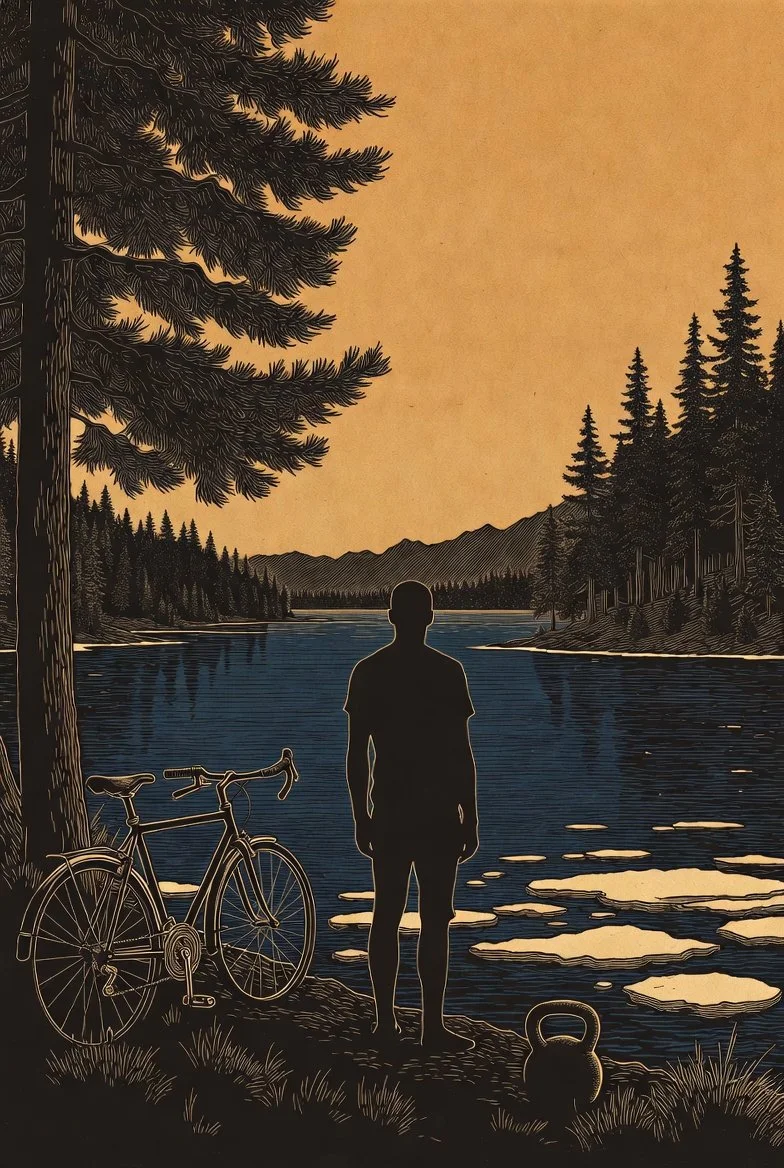
Bike.
Kettlebells.
Trash.
Ice bath.
Then again. Ice bath, twice.

I connected with Jennie.

Friends are coming over tonight.
I don’t have to be “on.”

Life is continuing in small, sane ways.

Today I chose to move.
Movement kept me from disappearing.

Today's Post

Today’s Daily Post — I don’t really have one.

I’m working with the content of my actual life and time right now…
and honestly?

It’s all over the place.

We’ve got the Renee Good crisis in Minneapolis.
Ongoing conversations about whether AI is “woke” or not.
Deep dives into large language models and their inability to truly enter a hard, deterministic execution mode.
Questions about honesty with AI itself.

Layered on top of that:
my own triggers around responsibility, growth, and integration.

Expanding the gap.
Mining the trigger.
Living with the revelation once it lands.

Somewhere in the middle of all that, I squeezed in a workout.
Played a game with my wife, who’s home sick today.
And we had some really good, real conversations about how to be better coaches—for ourselves and for others.

It doesn’t resolve neatly.
There’s no clean through-line today.

But if this is a scrapbook of my life, then this—
this messy convergence of events, ideas, effort, love, and inner work
is exactly where I’m at right now.

Good Monday to you all.
What’s cooking in your world?

Under My Own Tent

Under My Own Tent

I thought if I did enough
carried enough
stood steady long enough

…was enough.
Not too much.
Not too little.
Just enough.

Someone would finally say:
yes, this is enough.

But here I am,
with my hands empty,
and the accounting still open.

I feel it in my throat first.
That tightening.
That old reflex to explain myself
line by line,
as if clarity were a currency
that could buy me belonging.

I’ve built shelters for others.
I’ve held the poles.
I’ve stayed through weather
that wasn’t mine.

And now I’m standing
under my own tent
with no fire,
no audience,
just a wide, unoccupied heart.

I could bend.
I could soften the edge of what I see.
I could say the easier thing
and keep the circle easy.

But something in me
won’t kneel anymore.

Not in anger.
Not in pride.

Just refusal
to leave myself again.

I might lose you this way.
I know that.

Still, I stand.

Under the Bridge

Under the Bridge

I thought Under the Bridge was a love song to Los Angeles.
An ode.
A vibe.
The city of my youth humming back at me through speakers and memory.

But like so many things in life, there are layers.

It turns out it’s a song about isolation.
Loneliness.
Addiction.

Something Anthony Kiedis never meant to be a song at all.
Too vulnerable. Too sentimental. Almost embarrassing.

And then Rick Rubin heard it.
And said, simply:

Love to hear it.

And somehow—through that witnessing—
one of the best songs they ever made was born.

Here’s the pivot.

What I usually sing.

I usually sing from after the fire.
After the burn has cooled enough to touch.
After I’ve found the pattern, the meaning, the myth.

I sing competence.
Orientation.
Presence.

I sing from the place where I’ve already survived.

But Under the Bridge doesn’t sing from there.

It sings from before survival.

“I don’t ever want to feel like I did that day.”

We all have one of those days.
I do too.

The day under the bridge of abandonment.
Betrayal.
Shame.

The moments I usually move past quickly—
turn into insight, or wisdom, or strength—
before I ever let them be seen.

Rick was there to hear what Anthony was trying to hide.
To recognize the thing that wanted to be deleted.
And to say: that’s the song.

We all need that witness.
The one who sees what we’re about to throw away
because it feels too exposed to share.

Sometimes that witness is a person.
Sometimes it’s a place.
Sometimes it’s a song.

This song asked me to remember a time before I figured things out.
When isolation felt normal.
When concrete and distance were familiar companions.

I didn’t want to talk about that part.
It felt too exposed.

I usually move past those moments quickly.
This song didn’t let me do that.

It didn’t ask for meaning.
It didn’t offer comfort.

It just said:

Love to hear it.

Emirikol the Chaotic

THE IMAGE IS A PROMISE

I must have stared at that picture a thousand times.

Emirikol the Chaotic—tearing through a medieval street on horseback, magic blazing, bodies in his wake. I’d sneak my Dungeon Master’s Guide into class, crack it open under my desk, and there he’d be. Every time.

That image was pure promise.
Adventure. Danger. Mattering.

I didn’t analyze it.
I just knew: I want that.

Fast forward a few decades.

I’m scrolling through Facebook and stumble onto these D&D AI art pages—people taking those old black-and-white illustrations and colorizing them with Sora. And there he is again. Emirikol, now glowing in amber and gold, fire and shadow.

Nostalgic hit.
Fun little dopamine bump.
Cool, right?

But then I look closer.

And I see it differently.

Oh.

This isn’t just a D&D scene.

This is my whole fucking life.

Look at what’s actually happening in that street:

Someone burning alive.
Another hit mid-spell.
A mother fleeing with her baby.

Chaos. Pain. Life already on fire.

And there—stepping out of the Green Griffon tavern—is the hero.

No name.
No backstory.
No guarantee he wins.

Just this question:

Will you step into the street or not?

That’s the promise.

Not that adventure is coming.
That it’s already here.

The chaos isn’t waiting for you to be ready. Emirikol doesn’t ask permission. Life doesn’t care if you feel prepared.

Something’s burning.
Someone needs you.
The moment is now.

And you decide:
Do I step out of the tavern?

This is marriage when it’s hard.
This is fatherhood when you don’t know what to say.
This is business when the money’s running out.
This is faith when the answers don’t come.

This is masculinity.

Not the Instagram version—
the sweaty, uncertain, I’ll do it anyway version.

You don’t get guarantees.

You get a moment where something terrible is already happening, and you decide whether you engage.

And here’s what that old D&D image understood:

The picture doesn’t tell you how it ends.

Maybe the hero wins.
Maybe he doesn’t.
Maybe he’s corpse number four in thirty seconds.

But the story happens because someone chose to step into the street.

That’s the promise.

Not victory.

Participation.

Addicted to the Shindig

Something moves through me.

It isn’t polite.
It isn’t scheduled.
It doesn’t ask if this is a good time.

It hums.
It knocks.
It paces the room.

I feel it when I wake up with an idea already half-formed.
I feel it when a sentence wants to be spoken, even if no one is listening.
I feel it when stillness turns into stagnation and rest starts to rot.

This thing is not ambition.
It’s not hustle.
It’s not productivity.

It’s closer to weather.

A current.
A pulse.
A rhythm that says: get going.
Move.

Some people try to shut it down.

They sedate it.
Numb it.
Drown it in screens and snacks and safe little routines that never ask anything of them.

They call it peace.
But it isn’t peace.
It’s sedation.

Real peace has movement in it.
At least for me.
Real peace breathes.

Life doesn’t ask us to be perfect.
It asks us to be in it.

This isn’t a rehearsal.
This isn’t a read-through.

This is the show.

To choose not a life of imitation.
To stop sanding down the edges that make us human.
To stop apologizing for the part of us that wants to build, speak, create, initiate.

This creative drive—this restless, holy
(sometimes it feels unholy)
pressure—

is not a problem to solve.

It’s an embrace to surrender to.

Surrender doesn’t mean collapse.
It means cooperation.

It means listening closely enough to know when the current is moving—
and diving in when it calls, instead of fighting it.

Sedation says:
Stay small.
Stay comfortable.
Don’t risk looking foolish.

Surrender says:
Trust the motion.
Let it carry you.
You’ll figure it out as you move.

And here’s the truth most people miss—
or at least I missed for a long time:

The cost of not answering that call
is always higher
than the risk of answering it.

Because when you ignore it long enough, it doesn’t go away.

It turns into anxiety.
Into bitterness.
Into that quiet, grinding sense
that you are betraying something essential.

Some of us can’t stop.

Not because we’re broken—
but because we’re aligned.

Sometimes it even feels like the whole thing is happening for you—
like you’re both the audience and the performer,
watching yourself become
what you were always meant to be.

You get addicted to the shindig.

Because when we move with the rhythm instead of against it,
life stops feeling like resistance
and starts feeling like music.

The Bear Awakens - January 5th, 2026

Good morning. And Happy New Year.

The holidays are officially over.

Yes—College Football Playoffs are still rolling, and the Pro Football playoffs are about to begin.
But it's time to wake the bear.

It's time to BEGIN.

The new year itself is an arbitrary symbol.
But when you act on a symbol, it becomes leverage.
A hinge.
A moment where you get to choose.

And as I step from the den, I choose to re-engage on all fronts.

Front #1 — Body.
Movement. Weights. Stretching.
Fitness and fuel.
Time to get the engine warm again.

Front #2 — Being.
Spirit. Meaning. Memoirs.
Who am I? Why am I here?
Orientation. Alignment.
Remembering my higher self and the purposes I'm here to serve.

Front #3 — Balance.
Partner and posterity.
Every day, connect with the ones I love.
Tend the heart.
Stay alive in the body and the emotions.
There's real work here—and it matters.

Front #4 — Business.
The mind.
Discovery and declaration.
Learning. Growing.
Hunting the buffalo.
Providing—for my family and for myself.

The last two weeks were filled with food.
Now it's time to move again.

Filled with family—
all the beauty and all the friction that comes with that.

Filled with quiet moments:
reflection, pause, breath…
even emptiness.

And filled with learning.
Teaching.
Processing.

Now it's time to refine.
To clarify.
And to act.

Movement.
Using my hands to create in the world.
Showing up.
Hitting singles.
One day at a time.

The bear is awake.

New Years Eve 2025

New Year’s Eve.

And I’ve got nothing.

No desire to move or do anything.
Whiteboard? Empty.
General’s Tent? Empty.
Body plan? Being plan? Balance plan? Business plan?

Nothing.

I feel like Papa Bear, bedding down for a big, fat nap of nothing.
What do the French call it? Ennui.

Life will certainly come at me, and it behooves me to prepare—to come at it in return.
But right now, I’m not going anywhere or doing anything.

I’m just… sitting.

I’m not unhappy.
I’m not depressed.
I’m just… not inclined to do anything at all in this moment.

If I sit long enough, maybe something will occur to me.
But right now…
I just sit.

PS: This is simply a report of the current state, not a diagnosis.

The Axiom I Refuse to Grant

The Axiom I Refuse to Grant

There is an unspoken axiom shaping much of our political discourse right now, and once you see it, you can’t unsee it.

It goes something like this:

If you are on the wrong side, you are not merely mistaken—you are stupid, uneducated, uncultured, morally suspect, possibly racist, and unworthy of serious engagement.

Once that axiom is accepted, everything else follows effortlessly.

Asymmetry becomes “reality.”
Moral hierarchy feels justified.
Inquiry narrows “appropriately.”
And boundaries quietly replace tragedy.

I refuse that axiom.

Not because I believe all positions are equally right.
Not because I deny harm, abuse of power, or real danger.
But because frameworks that begin by declaring whole groups of people morally illegitimate do something far more corrosive than argue—they foreclose understanding.

And once understanding is foreclosed, almost anything can be justified.

Moral certainty is not the same as moral strength

One of the great temptations of our time is to mistake certainty for confidence.

Certainty feels strong.
It feels clean.
It feels like standing on solid ground.

But certainty is cheap if it’s purchased by dehumanization.

When you start from the premise that your opponents are ignorant, evil, uncritical, or morally deficient by default, you no longer need to listen. Evidence becomes ornamental. Debate becomes theater. Disagreement becomes pathology.

At that point, you’re not persuading.
You’re sorting.

And sorted people don’t need to be understood—only managed, contained, or defeated.

History is very clear about where that road leads.

People can be wrong without being evil

This is the line I will not cross.

People can hold views I strongly oppose without being stupid.
They can defend borders, laws, traditions, or limits without being racist.
They can distrust institutions without being uneducated.
They can vote differently without forfeiting moral seriousness.

Once we collapse disagreement into defect—uncultured, dumb, immoral—we are no longer doing ethics. We are doing excommunication.

And excommunication has a body count.

Why this posture has always felt “weak”

For most of my life, this refusal felt like weakness.

I watched others speak with absolute certainty, draw hard moral lines, name villains, and receive applause. Meanwhile, I hesitated. I paused. I wanted to understand before condemning.

That hesitation was framed—by others and by myself—as lack of confidence.

I see now that it wasn’t.

It was restraint.

It was a refusal to grant myself permission to hate in advance.

That kind of restraint doesn’t feel powerful in a culture addicted to outrage and moral sorting. But it preserves something far more important than dominance:

the human field itself.

The difference between confidence and approval-seeking

Here’s the shift that changed everything for me:

I stopped writing to secure approval.
I started writing from moral self-trust.

Approval-seeking asks:
Will this keep me safe? Will they accept me? Will I be attacked?

Moral self-trust asks:
Is this true to what I refuse to abandon, even if it costs me something?

When you write from moral self-trust, you don’t need to convince.
You don’t need consensus.
You don’t even need to respond.

You simply stand.

That kind of confidence is often labeled “dangerous”—not because it is violent, but because it cannot be steered by shame.

The axiom I refuse

So I’ll name it plainly:

I refuse frameworks that require me to declare my neighbors stupid, evil, racist, or morally illegitimate before I am allowed to understand them.

I refuse moral systems that turn disagreement into defect.
I refuse certainty that justifies dehumanization.
I refuse the idea that compassion and limits are opposites.

This refusal doesn’t make me neutral.
It doesn’t make me soft.
And it doesn’t make me naïve.

It makes me unwilling to trade my humanity for the comfort of certainty.

And that’s a trade I’m no longer willing to make.