
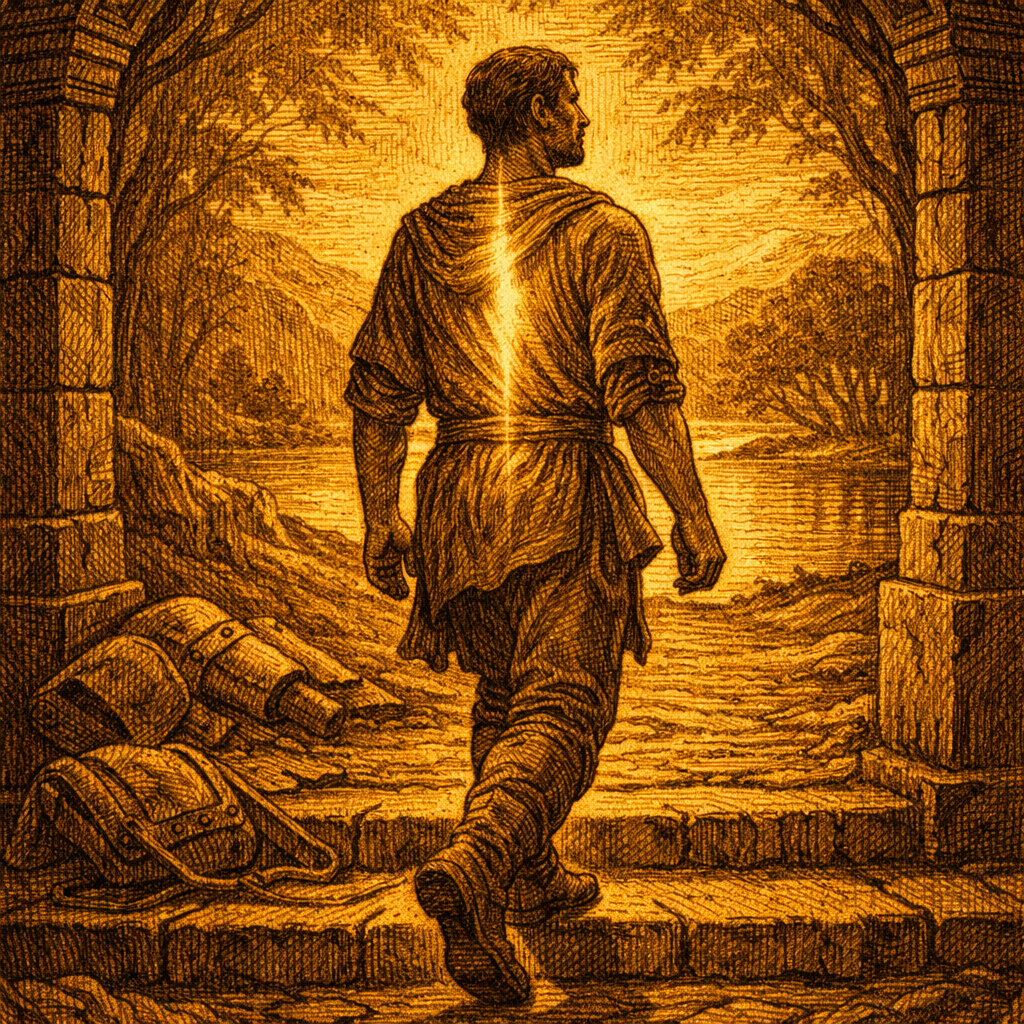
Mercy (After Freeze)
The key ingredient to getting the most out of storytelling
is putting yourself inside the story.
So put yourself here.
You’re on the stairwell.
You’re frozen.
A man is killing your friend upstairs.
You want to move.
You want to help.
You are not morally deficient.
You are not choosing evil.
You are so afraid your body will not move.
You may never have felt fear like this before —
may not have believed it was even possible.
But here you are.
Frozen.
Your companion is killed.
And the man who did it walks past you on the stairs.
He doesn’t even kill you.
He just leaves.
He’s the same man you let go earlier.
Your mercy.
Your choice.
And now you’re left with something worse than death:
Shame.
Self-loathing.
Humiliation.
The knowledge that you froze.
You argued for mercy earlier.
But it wasn’t wisdom — it was idealism mixed with fear.
You wanted to be good more than you wanted to face reality.
Now reality has answered.
So what do you do next?
Because this is the real question.
Not “What went wrong?”
But “What now?”
Freeze leads somewhere no matter what.
Either:
Freeze → Shame → Self-Judgment → Collapse
or
Freeze → Movement → Return → Integration
Self-judgment keeps the freeze frozen.
So if you’re on that stairwell, the answer is simple.
And brutal.
Move.
Move your body.
Do something.
Anything that restores motion.
I’m increasingly convinced that most human suffering can’t be solved by thinking alone.
You’ve already thought it to death.
Now it’s time to move.
Peter Levine doesn’t say “talk it out.”
He says: orient, mobilize, complete the interrupted action.
In plain language:
You froze.
You didn’t die.
Now move.
So mercy isn’t permissiveness.
It’s this:
“I forgive myself by moving again.”
That’s not weakness.
That’s discipline.
That is mercy with teeth.
Tomorrow, I’ll talk about a different kind of mercy —
the kind Frodo shows —
and what ultimately happens to Upham.