
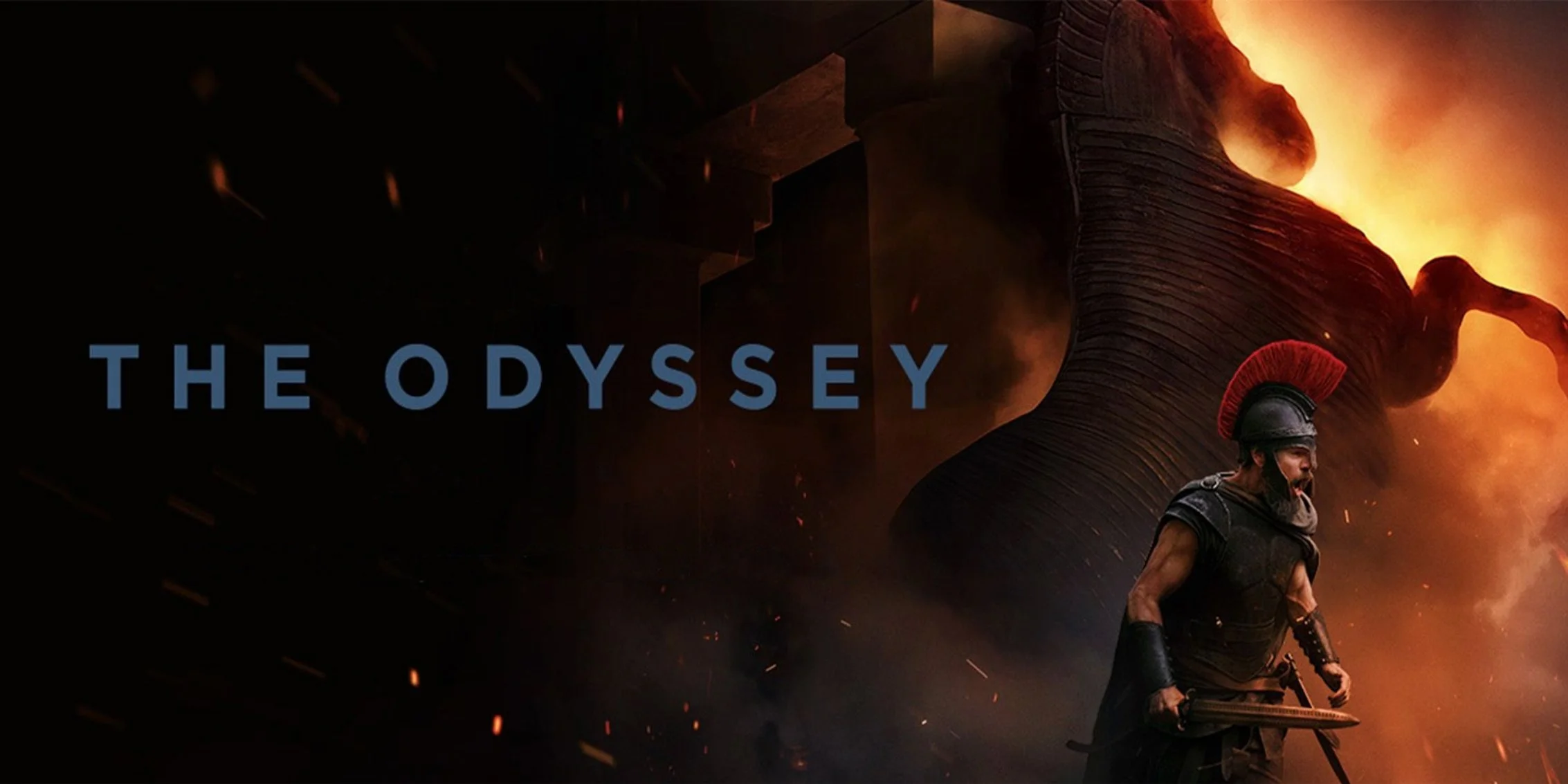
I went into The Odyssey wanting to love it. In fact, I kind of expected to be totally surprised by it. I watched it with an open mind. I wasn't rooting against it. In fact. But when the credits rolled, my overwhelming feeling wasn't anger or disappointment. It was boredom. And that's probably the worst thing I can say about a movie like this.
I think I finally figured out why.
For me, The Odyssey is fundamentally the story of a hero fighting to get home. Yes, Odysseus is flawed. Yes, he angers the gods. Yes, his pride brings consequences. But underneath all of that is a man who will crawl across the world, endure monsters, storms, temptation, and suffering because he loves his family, his kingdom, and refuses to give up.
That emotional engine is what drives the entire story.
This movie changed that.
Instead of watching a fundamentally heroic man struggling to return home, I felt like I was watching a man consumed by shame, convinced he didn't deserve to go home at all. Matt Damon didn't give a bad performance. I think he played exactly the character the filmmakers wanted. The problem is that I didn't want that Odysseus.
Instead of determination, we get resignation. Instead of longing, we get guilt. Instead of cheering for him to make it home, I found myself emotionally detached because he never seemed driven by that sacred desire to return. His homecoming wasn't triumphant. It felt perfunctory. To me, this felt like the deeper malaise that has infected our country. From heroic vision of individual triumph vs collective shame and guilt for our sinful past.
And if I don't deeply care whether the hero gets home...
...why should I care about the next island?
That's the heart of my criticism.
It also explains why I never connected with Penelope or Telemachus. I should have cared deeply about the wife who never gave up hope and the son who grew up believing his father would one day return. Their faith should have broken my heart. Instead, I never really felt connected to either of them. The emotional stakes never landed.
The monsters, the battles, the islands—they all became events instead of ordeals. The story lost its soul.
That same issue carried over into several of the performances.
Let's get the obvious casting controversies out of the way.
First, I honestly don't think they were major enough parts of the film to dramatically affect the overall narrative.
Second, my criticisms have nothing to do with politics.
The question for me is simple:
Did they convince me they were these people?
Elliot Page didn't.
Not because Elliot Page is transgender.
Because I never believed I was looking at an elite Bronze Age warrior. It wasn't the identity that took me out of the movie—it was the physical presence and the performance. If 300 had cast a very small, slight actor as one of Sparta's greatest warriors, I'd have had exactly the same reaction. Whether male or female, I simply never bought the character as someone who belonged among history's legendary fighters.
Zendaya surprised me even more.
I actually like Zendaya quite a bit. I thought she was excellent in Dune and charming in the Spider-Man films.
But she never convinced me she was Athena.
Athena should command the screen. She should radiate wisdom, strategy, authority, and divine confidence. Instead, I felt like Zendaya mostly sat there looking beautiful while collecting an $8 million paycheck. Again, that isn't an attack on her talent. It just felt like a miscast role.
Nuout Luonga is actually the opposite.
I thought she acted well.
My issue wasn't her performance—it was world-building.
She occasionally pulled me out of the film because she didn't feel like she belonged within the visual language of this particular version of ancient Greece. Had the story established that Helen was a princess from some distant kingdom, I could have completely bought into it. Great. Tell me that story. Give me that context. Without it, she simply felt disconnected from the world around her.
That leads to a broader point that I know will be controversial.
There's a difference between asking, "Can actors of any ethnicity perform Shakespeare?" Of course they can. Theater has been doing that brilliantly for centuries.
That's a completely different artistic question than asking whether a particular film creates a cohesive world.
Imagine Coco and deciding to randomly sprinkle in Scandinavian, Asian, and white villagers with no explanation. Or imagine Braveheart suddenly introducing samurai. Or feudal Japan populated by Roman senators. None of those choices are automatically wrong because of the actors—they simply disrupt the internal consistency of the world the movie is asking us to believe.
That's what I occasionally felt here.
I wasn't offended.
I just noticed it.
As for the rest of the principal cast, Robert Pattinson at least committed. I thought he occasionally drifted into being a little over-the-top when I would have preferred someone quieter, more cunning, and more genuinely frightening.
Anne Hathaway, who is an excellent actress, also felt miscast to me. Whether that was her or simply the way the character was written, I'm not sure.
Tom Holland gave a solid performance, but I never found Telemachus particularly compelling. That may be more of a writing problem than an acting one. He spent so much of the film feeling uncertain and passive that I never experienced the transformation I was hoping for.
Visually, the film didn't land for me either.
I've heard many people praise the cinematography, and I completely understand why. Some viewers will genuinely love the muted palette and restrained look.
It simply wasn't for me.
When I think of the Mediterranean, I think of brilliant sunlight, deep blue water, white stone, bronze armor, and vibrant life.
This film felt dark, gray, subdued, and emotionally muted.
Ironically, maybe that's exactly the point.
That visual language perfectly matches a version of Odysseus who is ashamed, guilt-ridden, and doesn't believe he deserves to go home.
It's internally consistent.
It just isn't the version of The Odyssey that moved me.
In the end, I don't think this movie failed for me because of the monsters, the special effects, or even the casting.
I think it failed because it changed the emotional center of the story.
For me, The Odyssey is about hope.
It's about perseverance.
It's about a man who refuses to let gods, monsters, or fate keep him from the people he loves.
Remove that heroic longing, and you haven't just changed a character.
You've changed the soul of the story.
And for me, that's why, despite all the talent on screen and behind the camera, I found myself bored instead of inspired.
I wanted to care.
I just never did.