
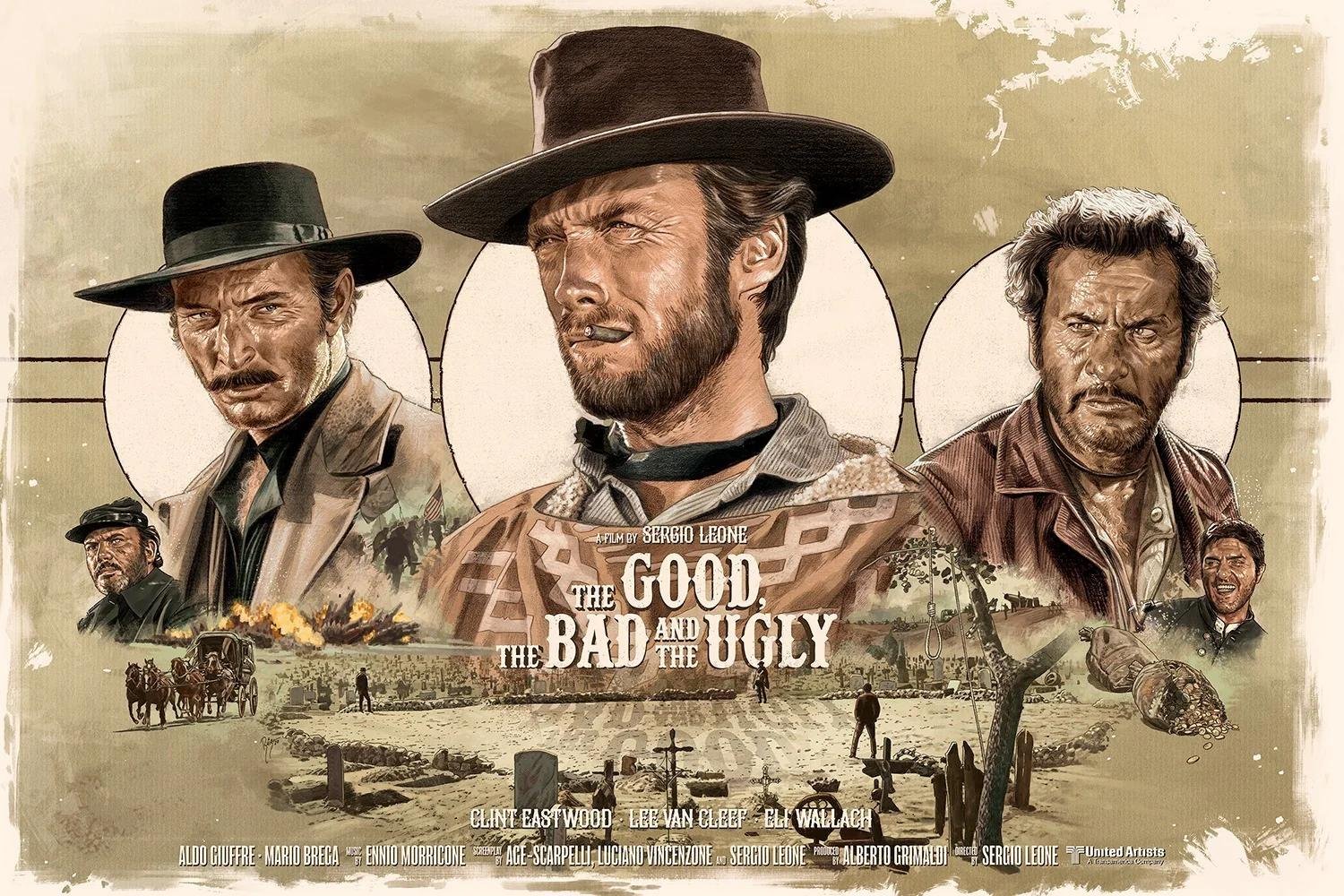
It Was Time
[This is an essay about The Good, the Bad and the Ugly. It's not a review. It's an essay, and as such has full spoilers.]
Somehow, despite being 57 years old and having watched a ridiculous number of movies in my life, I'd never seen The Good, the Bad and the Ugly.
Obviously I'd heard of it.
Clint Eastwood. The music. The squinting. The guns.
So a few nights ago, I decided it was finally time. About an hour in, I was thinking:
This might be one of the most boring fucking movies I've ever watched.
Okay, that's overstating it. But not by much.
It was beautiful. I could see the artistry immediately. Sergio Leone's enormous landscapes. The extreme close-ups. Ennio Morricone's incredible score. Just looking at Van Cleef was almost enough to save the beginning.
But I had one gigantic problem: I didn't give a shit about anybody. I didn't CARE.
The "Good" wasn't particularly good.
The "Bad" was definitely bad.
And the "Ugly," Tuco, was an insane, lying, backstabbing bastard.
Everybody wanted money… and that didn't seem like a great motivation for me to spend 3 hours with these assholes.
There was no Frodo trying to save the Shire. Nobody trying to save their family. No nobility at all.
Just three guys chasing $200,000.
One of the things I do with ChatGPT is we watch movies together. It's an entertaining, educating, philosophical debate between a human and a computer about some of the biggest movies, themes, and characters in the world.
So I kept talking to ChatGPT while I watched, which turned out to be half the fun.
I'd pause the movie and say things like:
"Why doesn't Blondie just fucking shoot Tuco?"
Because seriously. Tuco would capture Blondie. Blondie would escape. Tuco would capture Blondie again.
And eventually I'm yelling at the television:
SHOOT THIS FUCKER AND GO HOME.
Chat kept patiently explaining:
"This isn't really tactical realism. Leone is operating in myth."
And that was really helpful… to reconsider the story as a great mythological undertaking.
MYTH.
I started accepting that, seeing, and actually enjoying. A cannonball miraculously saves somebody. Tuco survives some ridiculous catastrophe. Clint Eastwood lights the fuse of an actual fucking cannon with his cigar and fires it at Tuco.
And strangely, once I stopped demanding realism from the movie, I started understanding its language, its rhythm, its voice — and somewhere in there, I started caring about Tuco. (This one really blew me away… how Leone pulled this off was amazing!)
There was a scene where Tuco meets his brother, who's become a priest. For the first time, underneath all that noise and greed and violence, I saw the man. Afterward Tuco tells Blondie about it. Blondie doesn't give him some heartfelt speech. He just hands him a cigar. That was it. Ten seconds. And I remember telling Chat:
"That's the first emotional moment in the entire movie."
Later Tuco gets the shit beaten out of him by this enormous bounty hunter named Wallace, and suddenly I desperately wanted him to get revenge — which floored me, because an hour earlier I'd wanted Blondie to just shoot the guy. Now I was rooting for him.
And that became one of the fascinating parts of watching the movie this way. Instead of discussing it afterward, Chat and I were essentially documenting my relationship with the movie while it changed. It was fun to see older versions of Jason (1 hour earlier) and how he evolved as the story evolved.
And eventually I started seeing what Leone was building.
The Good. The Bad. The Ugly.
One treasure between them. One cemetery to meet in.
Of course these three men eventually had to meet. I actually predicted that long before it happened. It HAD to happen.
Though writers sometimes become terrified when audiences can predict where they're going.
"Oh shit. They'll see it coming. I need a twist!"
No.
Sometimes the audience should see it coming.
The three men HAD to meet at that cemetery. Anything else would have betrayed the story.
Chat and I started joking about some hypothetical version where Sergio Leone decided the obvious ending wasn't clever enough.
"But Sergio, Angel Eyes has to arrive at the cemetery. You've built the entire movie toward—"
"NO! TOO PREDICTABLE! DYSENTERY!"
Angel Eyes dies beside a cactus twenty miles away.
FIN.
"A daring subversion of narrative expectation."
Congratulations Sergio... you surprised me.
And you fucked your movie!
I laughed so hard I had tears running down my face.
Because we've all seen stories do exactly that. They mistake surprise for payoff.
But Leone understood the difference. He took us exactly where the story had promised to take us.
The cemetery.
As I looked at this monstrous thing that Sergio actually built in Spain, and I considered the set pieces, the civil war, the cannon fire… I had to admit, this guy had a vision, and he fucking executed it.
Thousands of graves arranged in this enormous circle.
Tuco runs through them while Morricone's The Ecstasy of Gold explodes around him.
And suddenly this weird, slow, occasionally frustrating movie becomes absolutely mesmerizing.
And I only had one question: Would Leone stick the landing? I'm 3 hours in, and now I'm 100% his captive audience. It's up to him though, he's got me… but will he deliver the goods?
Tuco finds the grave.
A shovel lands beside him.
Blondie.
Then another shovel.
Angel Eyes.
Good. Bad. Ugly.
There they are.
And Leone puts them in a circle.
Three men. Three guns. One fortune.
Just like I predicted… but in a way I could never have expected.
That's the true secret here.
And now something cool happens.
You start thinking.
Who shoots whom?
If you're Blondie, you assume Tuco shoots Angel Eyes.
But Angel Eyes knows that.
Does Angel Eyes shoot Tuco?
Does Blondie shoot Tuco because he knows Tuco will shoot Angel Eyes?
Does everybody shoot everybody?
Leone spends minutes showing us nothing but:
Eyes. Hands. Guns.
Eyes. Hands. Guns.
And Morricone keeps tightening the spring. That score! As much a part of the story as the visuals.
Then the gunfire cracks, and it's over almost as fast as it started — Angel Eyes goes down into a grave, the Bad is gone, and it's just Blondie and Tuco left standing.
And this is where the entire movie pays off.
Because Blondie could take everything.
He has the gun.
Tuco is helpless.
The gold is right there.
And earlier in the movie I had repeatedly asked:
WHY DOESN'T BLONDIE JUST KILL TUCO?
Now I knew he wouldn't.
Somewhere during those three hours, these two assholes had become something resembling friends.
And Leone brings us all the way back to where their relationship began.
A noose. Tuco's neck inside it. Blondie riding away with a rifle.
At the beginning of the movie, Blondie shot Tuco's rope because there was money in it.
Now he doesn't need Tuco anymore.
He could take all $200,000.
Instead, he leaves Tuco half.
Then rides into the distance.
Stops.
Raises the rifle.
Fires.
The rope breaks.
Tuco falls directly onto his $100,000.
The Ugly gets his gold.
The Bad lies dead in a grave.
And the Good rides away having chosen not to take everything simply because he could.
Holy shit.
That's when I realized:
The movie was never about the fucking gold.
The gold was simply the thing that kept Blondie and Tuco together long enough for a relationship to happen.
And that's why the ending feels so unbelievably satisfying.
There's a strange thing that happens when somebody gets a story exactly right.
You don't necessarily say:
"Wow, I never could have imagined that."
You say:
"Of course."
Of course Blondie shoots the rope.
Of course Tuco gets half the money.
Of course Angel Eyes ends up in a grave.
Once you've seen the ending, it feels like there couldn't possibly have been another one.
That's one of my deepest beliefs about storytelling.
Maybe it's woo-woo. I don't really care.
I've written stories where I've walked for hours trying to find what happens next.
Not invent it.
Find it.
And when you finally find the right story, there's this strange recognition.
There you are.
That's what was supposed to happen.
And Sergio Leone fucking found it.
By the time Clint Eastwood rode away and Tuco screamed after him while Morricone's music exploded—
I loved it.
Not because the movie became something different.
Because after nearly three hours of fighting with it, I finally understood what it had been doing all along.
And damn.
It got the story right.